Lift: AI Photo Editor
- 4.2
- Rating
- 1.00M
- Installs
- Free
- Price

 Analysis by App-foxy
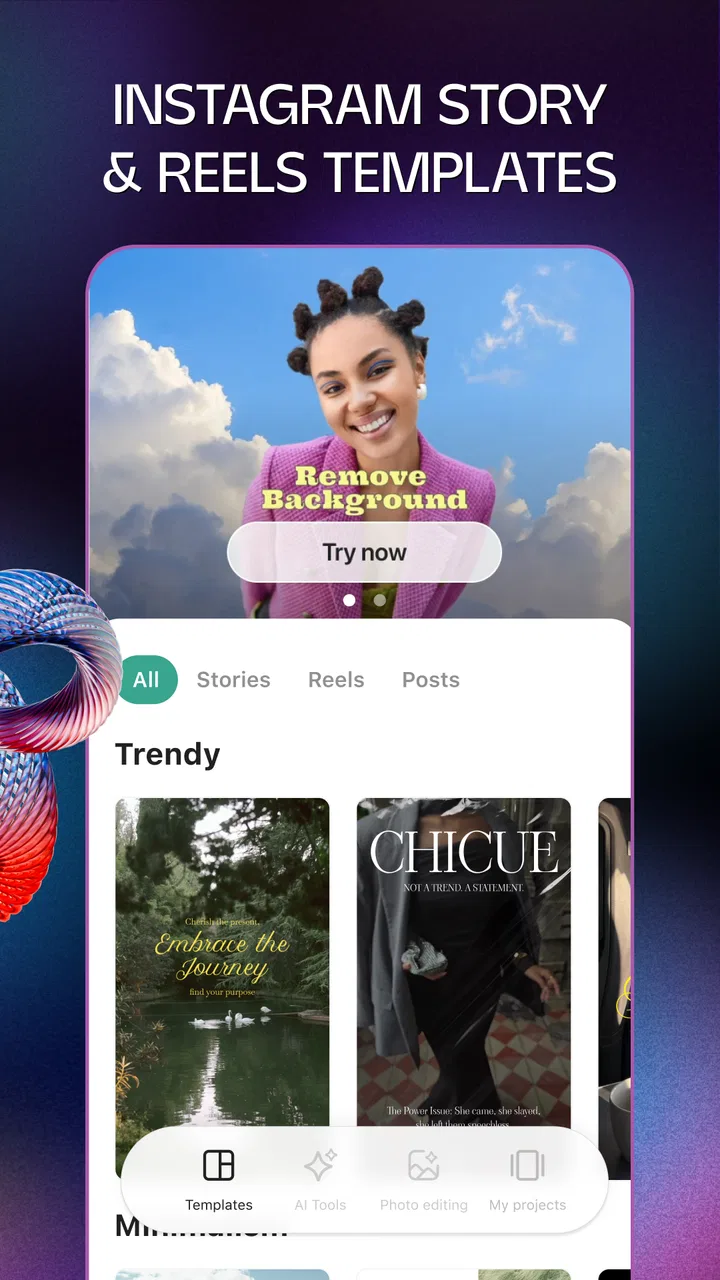
I approached Lift: AI Photo Editor as the kind of photography app you open when a normal snapshot needs to become a finished post quickly. It is free to start, made by Lift App, and aimed at editing photos, videos, and stories through a large collection of templates. My first impression is that it is less about replacing a full desktop editor and more about helping you reach a polished result without building every design element from an empty canvas.
That distinction matters. If you want detailed control over individual adjustments, layers, or a carefully managed color workflow, a traditional photo editor may still suit you better. If your priority is turning a phone image into a social-ready composition, Lift feels more approachable. I found the most useful way to judge it was not by asking whether it can do everything, but whether its guided editing style saves enough time to justify using it instead of the tools already on your phone.
What to consider before choosing Lift
I find the choice comes down to whether a guided layout helps you finish or gets between you and the image. Before settling on Lift, I’d test it with the kind of photos and stories you actually make, paying attention to how much adjustment feels natural on your phone. That makes it easier to judge the practical trade-offs before deciding where it fits in your routine.
You May Also Like

 Blood Strike: 2.5 Anniversary
Blood Strike’s Loadouts Turn Every Drop Into a Tactical Gamble
A close look at Blood Strike’s custom loadouts: how fast access to signature weapons reshapes its battle royale rhythm, rewards preparation, and narrows the gap between fights.

 Pandora - Music & Podcasts
Pandora’s Music Is Easy to Start, but Harder to Recover
Pandora’s strength is its low-effort path from a seed to a station. Its weak spot is how much confidence it asks you to place in connection, setup, and quiet recovery.

 8 Ball Pool
 Is Built on Rivalries, Rematches, and Routine
A close look at the rivalries, rematches, shared routines, and unanswered safety questions that turn a quick pool match into a persistent mobile community.

 Samsung Music
’s Quiet Strength Is Playing What You Already Own
Its reach comes less from spectacle than from dependable access to a personal library. That simplicity is both the app’s strongest retention engine and its ceiling.

 AccuWeather: Weather Radar
AccuWeather Review: A Quick, Clear Forecast for Everyday Decisions
For everyday plans, the best forecast is the one you can understand quickly. AccuWeather makes rain timing, radar, and local conditions easy to act on, with a few trade-offs.

 Hill Climb Racing
Why Hill Climb Racing Still Turns Crashes Into One More Run
A tiny car, a bumpy hill and one more upgrade: Hill Climb Racing keeps resurfacing because its simple chaos makes every near-miss feel personal.
More From Our News Desk



Start with the kind of result you need
The app makes the most sense for people who think in finished formats: a story, a promotional image, a short visual sequence, or a post that needs more structure than a single unedited photograph. The template approach gives you a starting point, so you are choosing a visual direction before spending time on small adjustments. That can be a real advantage when you know the message you want but do not have a designer’s instinct for spacing and composition.
I would not choose it solely because it is labeled an AI photo editor. That phrase can create expectations of automatic perfection, while the practical value here is the combination of guided layouts and editing tools. The result still depends on the source material, the template you select, and how much you refine the text or imagery. The app can accelerate decisions, but it cannot rescue every poorly lit or awkwardly framed photo.
Compatibility is straightforward for many current devices, since the app requires iOS or Android version 11 or later. That is worth checking before installing it on an older phone. The age classification is Everyone, which makes it suitable for a broad audience, although the finished content you create will naturally depend on your own images and wording.
Think about speed versus control
My main decision criterion was how quickly I could move from an idea to something shareable. Lift is strongest when I do not want to spend ten minutes aligning elements, testing type combinations, and deciding how much empty space to leave around a subject. A template narrows those choices and gives the project a visual rhythm immediately.
The trade-off is that a guided design can also feel restrictive. A layout that looks excellent with a portrait may feel unbalanced with a landscape photo. Instead of forcing one template to work, I found it more efficient to try a few starting points and then make only the changes that improved the image. That workflow is faster than rebuilding a design, but it still requires judgment.
Use the reputation as a signal, not a guarantee
Lift has passed the one-million-install mark and holds an average rating of 4.2 from roughly sixteen thousand ratings. Those figures suggest a substantial audience and a generally positive reception, but they do not tell me whether every template, export, or editing session will match my needs. I treat that kind of store feedback as reassurance that the app is worth testing, not as a substitute for checking its fit with my workflow.
The current release is version 2.15.0.b5. I would keep the app updated if I relied on it for regular content, especially because template-based services can change their editing experience over time. The developer is Lift App, and the app is free to download, with optional purchases ranging from $1.99 to $59.99 per item. That pricing range makes it important to explore the free experience first rather than assuming every attractive design is included.
Where Lift earns its place
Once I know a template-led workflow suits my material, Lift earns its place as a handy bridge between a quick gallery edit and a more involved design session. I’d use it when a post needs a consistent visual shape across different media, while keeping a manual editor for work that depends on exact control. The next question is which everyday projects benefit most from that middle ground.
Templates remove the blank-page problem
The strongest part of the experience is the way templates turn design into selection and refinement. Instead of beginning with a blank project, I can start by asking what kind of visual treatment suits the material. This is particularly helpful for someone who has a good photo but no clear idea how to present it. The template acts like a rough creative brief: it suggests hierarchy, placement, and the amount of information the image can carry.
A useful trick is to choose a template based on the subject’s shape rather than its color. A close portrait needs room around the face, while a product or travel image may benefit from a broader visual field. Starting with the wrong structure often leads to unnecessary cropping and moving elements around. Starting with the right structure lets me spend my time on the content instead of fighting the layout.
This is also where Lift feels different from the basic editor built into a phone gallery. A gallery editor is excellent for quick corrections such as brightness, cropping, or rotation. Lift is more useful when the image needs presentation: a frame, a visual sequence, or a designed story rather than a corrected photograph.
It suits mixed media better than a single-image tool
Because Lift works with photos, videos, and stories, I can use the same general creative habit across several types of content. That is valuable for a small business owner, a casual creator, or anyone preparing a group of posts around one event. I do not have to think of a photograph and a short video as entirely separate projects when the goal is to give them a related visual identity.
In an everyday situation, imagine taking pictures at a weekend market and wanting to share more than one image. I would select a template for the opening story, use a second visual for a product detail, and finish with a short clip. The benefit is not merely speed; it is consistency. Even modestly edited pieces can feel like part of the same update when they use a related structure.
That workflow is especially helpful when I am working from a phone and making decisions in short bursts. I can prepare one piece while waiting for a train, revisit it later, and continue with another without needing a large screen or a complex project file. The app’s value is therefore tied to convenience as much as to its editing tools.
It helps non-designers make better first drafts
I think Lift is at its best for people who know what they want to communicate but do not naturally notice alignment, hierarchy, or visual balance. A template gives those users a sensible starting point. It does not remove the need to review the result, but it reduces the chance of producing a cluttered first draft.
One practical habit improved my results: I wrote the shortest version of the message before choosing a layout. Long wording can make a design feel crowded, while a concise phrase allows the image to remain the focus. If the template already has several visual elements, I would rather remove unnecessary text than shrink everything until it becomes difficult to read.
Another useful approach is to edit the image before becoming attached to the template. If the crop hides the important part of the photograph, the design is not doing its job. I would test the crop, check faces and product details, and only then adjust decorative elements. This prevents a common mistake in template apps: protecting the layout at the expense of the actual image.
It can make repeatable content less tiring
For recurring content, Lift can reduce the mental cost of starting again. A person posting weekly updates, a freelancer showing recent work, or a club sharing announcements may not need a completely new design every time. The advantage is the ability to begin with an established visual direction and change the material without reinventing the entire presentation.
There is a subtle trade-off here. Reusing a structure can create a recognizable style, but repeating the same look too closely may make a feed feel predictable. I would rotate between related templates rather than using one favorite for everything. That gives continuity without making every post appear copied from the previous one.
What I would check before paying
The free entry point is helpful because I can test the editing approach with my own photos before committing to anything. I would not judge the app using only the most impressive preview designs. I would check whether the available templates match the content I actually make, whether the editing steps feel comfortable on my phone, and whether the free selection is enough for occasional use.
Optional purchases are priced from $1.99 to $59.99 per item, so the difference between a small one-off purchase and a larger commitment is significant. I would consider paying only after identifying a repeated need, such as a style I use for ongoing work. For casual experimentation, the free version may be the more sensible stopping point.
Where a conventional editor remains better
A conventional editor is usually the better choice when precision is the main goal. If I need careful retouching, detailed masking, exact color correction, or a highly specific composition, a template-led workflow can get in the way. Lift helps me make a designed result quickly, but it is not the tool I would reach for when every pixel needs deliberate treatment.
The same applies to photographers who want their own visual language rather than a guided one. Templates are useful when I welcome a starting point. They are less appealing when I already know the composition and want complete freedom to build it from scratch. In that case, the app may add an extra layer of adaptation instead of removing work.
Basic social-media editors may also be enough for people who only crop, add a filter, and publish. Lift becomes more worthwhile when the post needs structure across multiple elements or media types. If I only make a quick correction to one image, opening a larger creative app may be unnecessary.
The switching cost is mostly creative habit
Moving to Lift is not difficult in the same way as changing a professional production system, but there is still a small learning curve. I need to understand which templates suit my images, how much text a layout can comfortably hold, and when to stop adjusting. The interface may feel simple at first, yet good results come from learning its visual limits rather than tapping through every option.
I would start with one realistic project instead of browsing endlessly. For example, I might prepare a short set of images from a family outing, a sale announcement, or a personal portfolio update. That gives me a clear test: can I finish faster than with my usual editor, and do I prefer the result? If the answer is no, the app has not earned a permanent place in my routine.
There is also a content-management cost. A template can make several pieces look related, but if I switch between unrelated styles without a plan, the result may feel inconsistent. I recommend choosing a small visual direction for each project and resisting the temptation to use every attractive option in one session.
Who should use it and who should skip it
I would recommend Lift to casual creators, small sellers, students, travelers, and social-media users who want more than a raw photo but less complexity than a professional design program. It is particularly suitable when speed, templates, and mixed photo-video storytelling matter more than fine-grained control.
I would be more cautious if I were a professional photographer, a designer who needs exact brand rules, or someone who dislikes preset layouts. Those users may get better results from an editor built around manual control. I would also skip it if I rarely create stories or designed posts and only need occasional cropping and exposure adjustments.
My recommendation after using it
Lift is a useful middle ground between a phone’s basic gallery tools and a full creative suite. Its real strength is not that it eliminates editing decisions; it makes the first important decisions easier by giving me a structured visual starting point. When I need a polished story or a coordinated set of images without spending a long time designing, that is a practical advantage.
I recommend trying the free version with your own material before considering an optional purchase. Test a photo, a short video, and a story-style project rather than relying on a single attractive template. If the guided workflow helps you finish content you would otherwise postpone, it is doing something valuable. If you keep wishing you could move every element freely or correct an image with professional precision, a conventional editor will probably be the better choice.
My final view is positive but specific: Lift is best for fast, template-led visual storytelling, not unlimited photo manipulation. It earns a place on my phone when presentation and momentum matter. I would use it to turn everyday material into coherent content, while keeping a more manual editor available for work where control matters more than speed.
FAQs for Lift: AI Photo Editor
01What is Lift: AI Photo Editor used for?
Lift: AI Photo Editor is designed for enhancing and transforming photos with artificial intelligence. It can help improve image quality, remove or replace backgrounds, apply creative effects, retouch portraits, and create stylized visuals. The app is aimed at both casual users and social media creators who want quick editing tools without needing advanced photo-editing experience.
02Is Lift: AI Photo Editor free to download and use?
Lift: AI Photo Editor may be available as a free download, but some editing tools, effects, templates, or export options can require a subscription or in-app purchase. Before starting an edit, check which features are marked as premium and review the trial, renewal, and cancellation terms. Availability and pricing may also vary between Android and iOS.
03Does Lift: AI Photo Editor require an internet connection?
Many AI-powered features in Lift may require an active internet connection because images are processed through online servers. Basic viewing or certain simple editing tools may work differently depending on the app version, but users should not assume that the full editor is available offline. A stable connection is especially important when uploading photos or generating AI effects.
04Are my photos safe when I use Lift: AI Photo Editor?
Before uploading personal or sensitive images, review Lift’s privacy policy and permission settings. AI editing can involve sending photos to remote servers for processing, and the app may collect technical or usage data according to its terms. Avoid uploading confidential documents or images you do not want processed online, and only grant access to the photos and features you actually need.
05Can Lift: AI Photo Editor export high-quality images without a watermark?
Export quality and watermark rules can depend on the selected tool, account type, and subscription plan. Some free edits may be limited in resolution or include branding, while premium features may offer cleaner exports and additional controls. Check the preview and export screen carefully before saving, particularly if you intend to print the image or use it for professional or commercial purposes.
Pros
- AI tools make complex edits accessible to beginners.
- Background removal works quickly for portraits and product photos.
- One-tap enhancement can improve dull or poorly lit images.
- Templates help create social-ready content with minimal effort.
- Regular updates add new creative effects and editing options.
Cons
- Many advanced tools and effects require a paid subscription.
- AI results can look unnatural with busy or low-quality backgrounds.
- Export options may be limited unless you upgrade your plan.
- Some edits take longer when processing high-resolution photos.
- The app may collect personal photos and usage data for its services.

Lift: AI Photo Editor
Gallery